
How 1-Click AutoFix and AI Remediation Save DevSecOps Teams Hours
Your security scanner has done its job. It found 500 issues.
Now comes the hard part: triaging Jira tickets, hunting down repository owners, context-switching through stack traces, writing manual code patches and testing pull requests. Finding vulnerabilities is no longer the bottleneck in modern engineering, remediating them at scale is.
1-Click AutoFix and AI Remediation fundamentally shift the DevSecOps model from passive alert generation to active, automated resolution.
When a standard application security scan uncovers hundreds of misconfigurations, vulnerabilities, and secrets leaks across cloud infrastructure, repositories and Kubernetes clusters, the bottleneck isn’t finding the problem. It’s the endless hours spent triaging Jira tickets, reading context, writing code patches, testing pull requests and validating fixes.
Enter 1-Click AutoFix and AI Remediation, the shift that moves security from passive detection to active, automated resolution.
How Zero-X AI Remediation Works
Zero-X (Zero-Execution/Zero-Exertion) AI Remediation operates directly within your modern CI/CD pipelines and source control systems. It converts complex security findings into ready-to-merge fixes without requiring manual developer intervention.
[ Security Finding ] ➔ [ AST & Code Graph Context ] ➔ [ AI Patch Generation ] ➔ [ Pipeline Validation ] ➔ [ 1-Click Merge PR ]
- Context-Aware Code Analysis
The engine ingests the scanner finding (CVE, secrets leak, or IaC drift) and uses Abstract Syntax Tree (AST) mapping to analyze the surrounding repository context. It understands your coding patterns, internal framework dependencies and build logic to ensure proposed changes don’t cause breaking API shifts. - Autonomous Patch Generation
Generative models synthesize the exact code modifications needed. Rather than offering vague guidance, the system writes functional syntax—whether that’s updating an HCL block in Terraform, adjusting an API endpoint, or bumping a vulnerable package while refactoring deprecated syntax. - Automated Verification & Unit Testing
Before a developer ever sees the fix, Zero-X runs localized unit and regression tests inside an isolated sandbox container. The patch is verified to close the specific vulnerability and pass existing CI builds without introducing performance regressions. - 1-Click Pull Request Delivery
The system opens a clean Pull Request directly in your repository (GitHub, GitLab, Bitbucket) containing:- A clear breakdown of the vulnerability solved.
- The exact diff file modifications.
- Passing build and test verification logs.
The DevSecOps Bottleneck: The Cost of Manual Remediation
Historically, the lifecycle of a single security vulnerability looks like this:
Why You Need an AIBOM in 2026
- Scanner flags an issue (e.g., an overly permissive IAM policy, an outdated dependency, or a vulnerable Terraform file).
- Context switching: Security passes a ticket to a DevOps engineer.
- Investigation: The developer spends 30–60 minutes reading the CVE details, locating the affected repository line, and figuring out what breaks if they change it.
- Drafting & Testing: A fix is written, a PR is opened and tests are run.
- Review & Merge: Security reviews the change and merges it.
Multiply this manual cycle across dozens of microservices, multiple clouds and daily deployment pipelines, and DevSecOps teams spend up to 40% of their engineering capacity just patching known issues rather than building product features.
How 1-Click AutoFix and AI Remediation Save DevSecOps Teams Hours
1-Click AutoFix and AI Remediation changes the paradigm from “Here is a list of your problems” to “Here is the solution, already built—just approve it”.
1. Context-Aware Code Fixes (Not Just Documentation)
Traditional scanners link to generic documentation pages or CVE links. AI Remediation analyzes your exact codebase, cloud context, and architecture dependencies to generate ready-to-merge Pull Requests (PRs). Whether it’s updating an Infrastructure-as-Code (IaC) configuration or replacing a vulnerable function, the fix is tailored specifically to your project.
2. Elimination of Triage Friction with 1-Click AutoFix
Instead of digging through log files, developers receive pre-validated patches right inside their Git workflow or security dashboard. With 1-Click AutoFix, resolving a misconfiguration or updating a broken dependency takes seconds literally the time it takes to review a diff and hit a button.
3. Attack-Path Intelligence & Real Risk Prioritization
Not all security findings carry equal risk. Zero-X Cloud correlates security risks across your cloud infrastructure, Kubernetes workloads, codebases, and AI pipelines to map attack paths. AI remediation prioritizes fixing the critical vulnerabilities that are actually exploitable in production first, saving hours otherwise wasted chasing harmless noise.
4. Zero-Friction CI/CD Integration
By embedding intelligent auto-remediation directly into your existing development pipelines (GitHub, GitLab, AWS, Azure, GCP), security guards operate silently in the background. Issues are remediated before code ever hits production, eliminating post-deployment emergency firefighting.
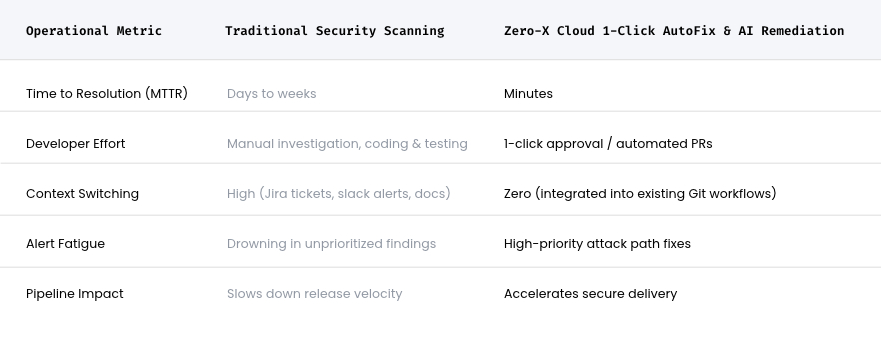
Manual Patching vs. 1-Click AI Remediation
The Business Value: Move from Detection to Automated Resolution
Security shouldn’t be a brake pedal for software delivery. By adopting 1-Click AutoFix and AI Remediation, organizations achieve:
- 60%+ reduction in operational effort spent on manual security fixes.
- Drastically lower Mean Time to Remediate (MTTR) for critical vulnerabilities.
- Happier engineering teams who spend time shipping features instead of chasing security debt.
- Continuous compliance across multi-cloud, Kubernetes and application environments.
Stop Detecting. Start Fixing with Zero-X Cloud.
Why spend countless hours manually resolving security tickets when AI can draft, validate, and present the exact fix instantly?
Zero-X Cloud unifies cloud infrastructure, application code, container and AI security into a single platform transforming noisy security alerts into instant, 1-Click AutoFix and AI Remediation workflows.

