
How to Unify Code, Cloud and Kubernetes Security
Navigating modern cloud-native environments often feels like managing three entirely different worlds: developer code, cloud infrastructure, and Kubernetes clusters. When these domains operate in silos, security teams end up drowning in disconnected alerts while critical vulnerabilities slip through the cracks.
To build a resilient defense, engineering and security teams need a single, coherent strategy to unify code, cloud and Kubernetes security.
The Challenge of Siloed Security
Traditionally, organizations secure their tech stack using fragmented tools:
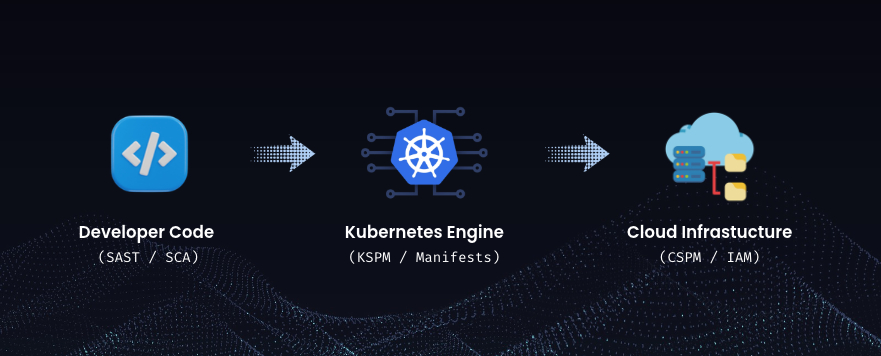
- Code Security: SAST and dependency scanners find bugs in code repositories before deployment.
- Cloud Security (CSPM/CWPP): Scans cloud provider configurations (AWS, Azure, GCP) to catch open S3 buckets or overly permissive IAM roles.
- Kubernetes Security (KSPM): Monitors running clusters, pod configurations, network policies, and runtime behavior.
When these systems don’t talk to each other, you lose critical context. A high-severity vulnerability in your code might seem low-priority on paper, but if it runs in a Kubernetes container exposed directly to the public internet on a misconfigured cloud instance, it becomes an active crisis.
3 Steps to Unify Code, Cloud and Kubernetes Security
Connecting these layers transforms security from a reactive bottleneck into a proactive, context-aware workflow
1. Trace Assets from Code to Cloud (and Back)
To effectively secure your architecture, you must map every running production asset directly to its original source code. When your cloud runtime alerts you to a compromised container image, your team shouldn’t waste hours identifying who owns the code. Traceability lets you pinpoint the exact repository, commit and developer responsible in seconds.
2. Correlate Risk with Environmental Context
Context is everything in cloud security. To prioritize threats accurately, evaluate risks across all three layers simultaneously:
- The Code: Contains a known CVE.
- The Kubernetes Cluster: Runs with elevated root privileges.
- The Cloud Infrastructure: Sits behind an Internet Gateway with direct public access.
By correlating these inputs, security teams can filter out low-risk noise and focus exclusively on high-priority attack paths.
3. Shift Left and Guard Right
Integration works both ways:
- Shift Left: Use Kubernetes manifest checks and infrastructure-as-code (IaC) scanning directly inside developer IDEs and CI/CD pipelines to block misconfigurations before deployment.
- Guard Right: Use runtime security monitoring across Kubernetes clusters and cloud resources to catch zero-day exploits and abnormal traffic in real time.
The Zero-X Cloud Approach
At Zero-X Cloud, we believe security should accelerate development, not stall it. By consolidating code scanning, cloud posture management and Kubernetes runtime protection into a unified platform, Zero-X Cloud gives your team complete visibility across your entire software lifecycle.
Eliminate tool fatigue, connect your security dots, and safeguard your infrastructure seamlessly from committing to the cloud.

