
What is an AIBOM? Why You Need an AI Bill of Materials in 2026

Artificial Intelligence has shifted from experimental sandboxes into core cloud production pipelines. Organizations rely on foundation models, fine-tuned micro-models, vector databases, and autonomous AI agents to run critical business workflows.
However, this rapid adoption has exposed a critical vulnerability: AI supply chain opacity.
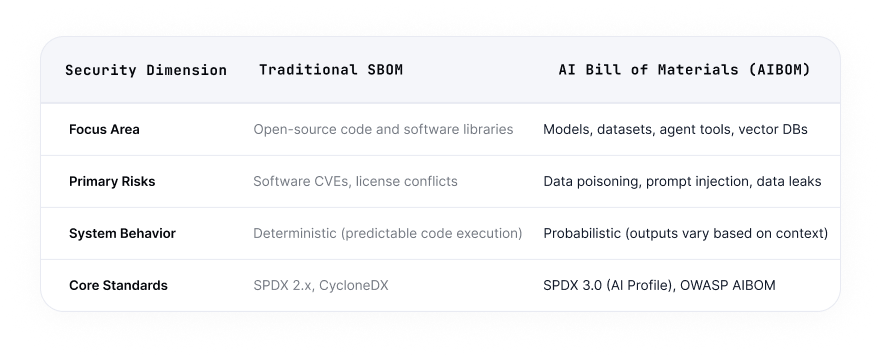
Just as the Software Bill of Materials (SBOM) became essential for tracking open-source code, the AI Bill of Materials (AIBOM) is now the standard for securing modern AI systems.
What is an AIBOM?
An AI Bill of Materials (AIBOM) is a structured, machine-readable inventory of every asset, dependency, and pipeline component that makes up an AI application.
Unlike traditional software, an AI application isn’t just code. It is a blend of code, probabilistic models, training datasets, dynamic context and runtime guardrails.
- Model Lineage: Base architectures, weights, version history, and source origin.
- Datasets & Data Sources: Training/fine-tuning datasets, data provenance, and copyright licenses.
- Agentic Tools & Frameworks: Integrated APIs, orchestration frameworks (e.g., LangChain), and vector vector stores.
- Safety & Guardrail Controls: Input/output filters, content moderation models, and prompt injection defenses.
Why You Need an AIBOM in 2026
1. Regulatory Enforcement Is Here
Regulations like the EU AI Act and frameworks such as the NIST AI Risk Management Framework (RMF) mandate clear data lineage and risk transparency for enterprise AI applications. Deploying unaudited AI models in the cloud risks compliance fines and stalled procurement deals.
2. Defending the AI Supply Chain
AI pipelines face unique attack vectors:
- Data Poisoning: Corrupting fine-tuning datasets to introduce operational backdoors.
- Model Tampering: Pulling malicious pre-trained weights from unverified repositories.
- Tool Hijacking: Exploiting vulnerabilities in third-party agent plugins and framework dependencies.
Without an AIBOM, security teams are blind when base model or data vulnerabilities are disclosed.
3. Enterprise Procurement & Vendor Audits
Enterprise buyers now demand proof that training data respects copyright laws and that AI stacks don’t leak sensitive data. An automated AIBOM converts weeks of manual auditing into an instant, verifiable report.
How Zero-X Cloud Automates AI Security
Managing an AIBOM manually using spreadsheets creates dangerous blind spots.
Zero-X Cloud brings full visibility across your Cloud, Code, and AI Security:
- Automated AI Asset Discovery: Instantly scan AWS, Azure, and GCP to detect models, datasets, and agentic workflows.
- Unified Risk Context: Connect vulnerabilities from software dependencies directly to cloud infrastructure and AI runtime environments.
- 1-Click AI AutoFix: Automatically remediate misconfigurations, exposed API keys, and insecure dependencies.
- Continuous Compliance: Generate real-time, audit-ready AIBOMs mapped against EU AI Act and OWASP guidelines without slowing down engineering.
End the Fatigue, Start the Fix
Alert fatigue isn’t cured by tweaking notification thresholds or hiring more analysts to sift through logs. It is solved when leadership stops treating “detection” as the destination.
By shifting your cloud security strategy from passive finding to active autofixing with Zero-X Cloud, you empower developers, clear backlogs, and secure your infrastructure in real time.

